## The Office Problem
The Office Problem
Maison Margiela doesn't make obvious workwear. There's no house blazer with a signature lapel, no trouser cut that reads "promoted twice in three years." The maison built its reputation on deconstruction, on garments that asked you to look twice, on white paint across leather and seams worn on the outside. That vocabulary doesn't translate easily to a place where people still expect jackets to button and hems to stay put.
But there's a version of Margiela that works in offices without announcing itself, without making your presence about your clothes. It requires editing. It requires knowing which pieces hold their form through a day of meetings and which ones are better saved for dinner. The friction here is real: you want the intelligence of the cut, the materials that Margiela does better than almost anyone, but you can't walk into a conference room looking like you're making a point about fashion.
The work is in choosing pieces that function first.
The Poplin Shirt
Start with Margiela's cotton poplin shirts, the ones without the deconstructed collars or the sleeves that pool at the wrist. The maison makes a straight-cut shirt in dense Italian poplin that sits close to the body without clinging, with a collar that holds its shape through a full day. No visible stitching, no raw hems. Just a shirt that happens to have better proportions than most of what's available.
The detail is in the shoulder seam, which sits slightly forward, and in the sleeve length, which is cut to show a half-inch of wrist even when your arm is bent. It's a small adjustment, but it changes how the shirt reads under a jacket. Margiela's tailoring assumes you move, that you're not standing still for a photograph. That assumption makes the shirt work harder.
Wear it with the top button undone. Tuck it in completely or leave it out completely—the half-tuck doesn't work here. The poplin has enough body that it won't billow. Expect to pay around $400, which is high for a white shirt but reasonable for one you'll wear weekly for two years.
The Trouser
Margiela's straight-leg wool trousers—not the wide-leg, not the cropped—are cut with a mid-rise that sits just below the navel and a break that barely touches the shoe. The fabric is a year-round wool from an Italian mill, with enough weight to drape but not so much that it looks formal. These aren't suit trousers. They're not trying to be.
The waistband is finished clean, no belt loops, which means you're wearing them at the natural waist or not at all. The side pockets are set at an angle that keeps the line flat even when your hands are in them. There's a single back pocket, which you won't use but which balances the silhouette.
Pair them with the poplin shirt, with a fine-gauge knit, with a cotton jersey tee if your office allows it. The trouser does enough on its own. You don't need to build around it. Margiela makes these in black, navy, charcoal, and a grey that's almost silver in certain light. Start with charcoal. It's the most forgiving.
The Knit
A merino crewneck from Margiela's mainline—not MM6, not a collaboration—is a different object than what you'll find elsewhere at the same price point. The gauge is fine enough that it works under a jacket, but the knit has enough structure that it doesn't collapse when you wear it alone. The neckline sits higher than most American crewnecks, which changes the proportion when you're not wearing a tie.
Margiela cuts their knits slightly long in the body, which sounds like a problem until you try one on. The extra inch or two in length keeps the hem from riding up when you sit, and it creates a cleaner line when the knit is worn untucked over trousers. The sleeves are cut slim, close to the arm, which keeps the whole thing from looking like borrowed comfort.
Wear it as a shirt replacement on days when a jacket isn't required, or layer it under a wool coat when the building's heat hasn't caught up with February. The merino is dense enough to hold warmth without bulk. Expect these around $500. They last.
The Bag
Margiela's structured leather totes—the ones without visible branding, without the paint treatment—are built for carrying a laptop, a notebook, a change of shoes, and nothing else. The leather is a matte calfskin that doesn't scratch easily, and the interior is finished clean, no logo lining. The handles are long enough to sit on your shoulder but short enough that the bag doesn't hang at your hip.
The shape is rectangular, slightly wider than it is tall, which keeps it from tipping when you set it down. There's a single interior pocket for keys and a phone, but Margiela doesn't over-engineer these. The bag is a container. It does what containers do.
Choose black or a dark brown that reads as neutral. This isn't the place for the maison's more experimental colours. You need something that works five days a week, that doesn't ask to be noticed.
What Not to Do
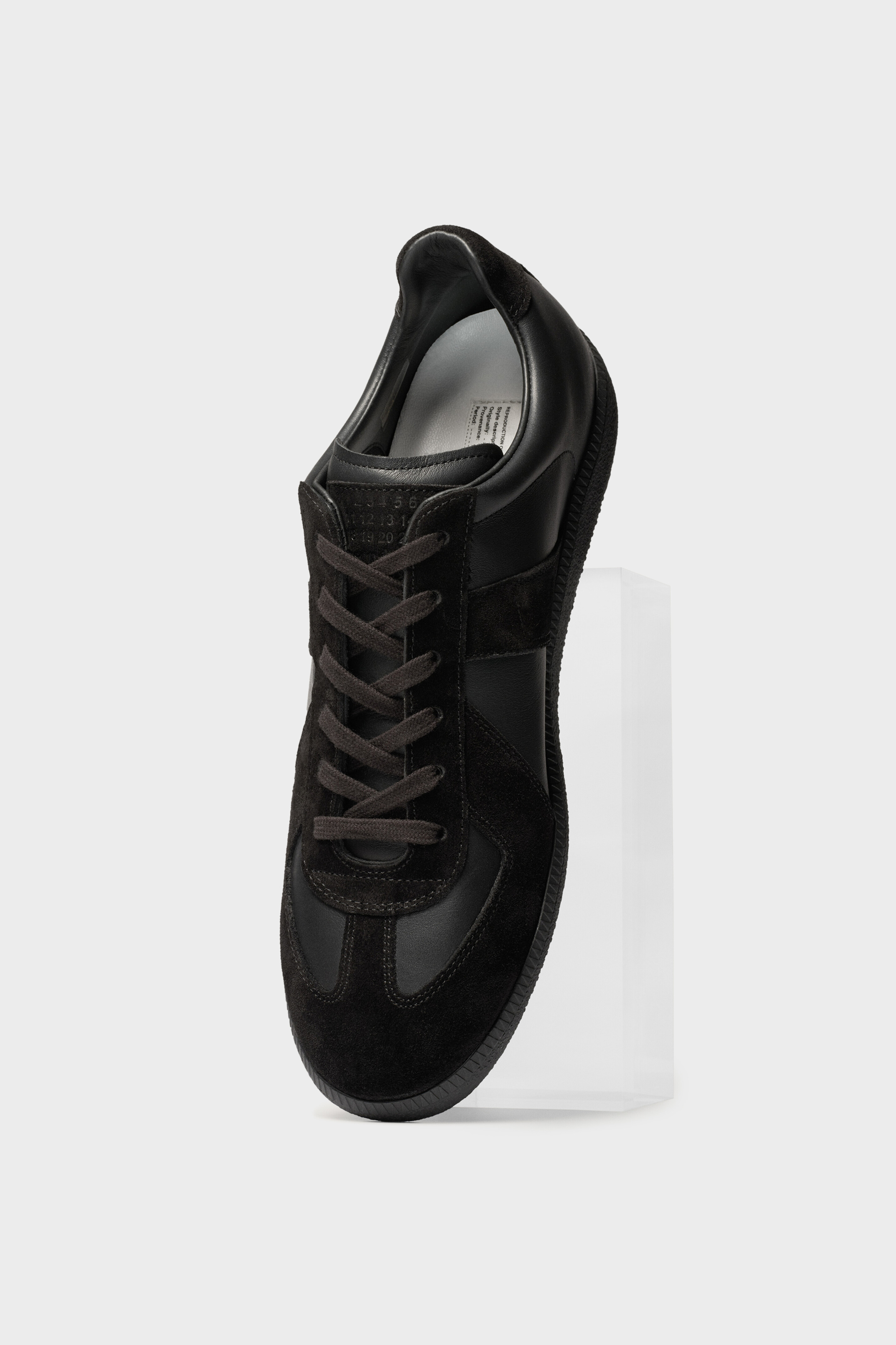
Don't wear the Tabi boots. Don't wear the deconstructed trench with the sleeves half-attached. Don't wear the sweater with the visible darning or the trousers with the exaggerated pleats. Those pieces are part of Margiela's language, but they're not the part that translates to an office.
Don't try to make every piece a Margiela piece. The maison's workwear functions best when it's surrounded by simpler things—a coat from elsewhere, shoes that don't have a point of view, a watch that just tells time. The goal isn't to dress in Margiela. The goal is to use a few pieces that make everything else look more considered.