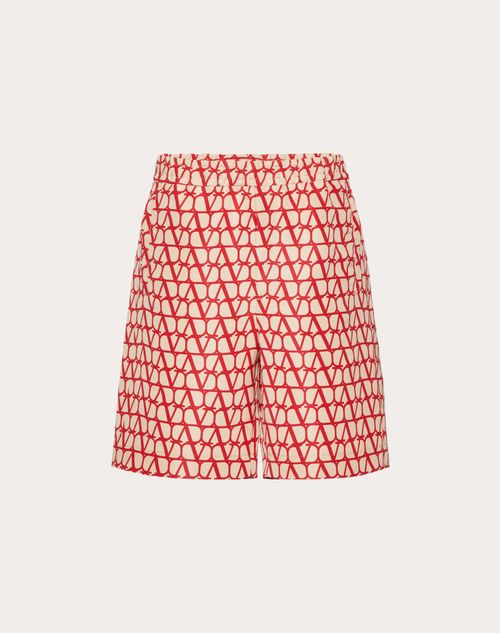
Valentino is cutting shoulders narrow again
Valentino is cutting shoulders narrow again. Not the exaggerated breadth of the Eighties, not the dropped sleeve-head of two seasons ago — this is something closer to the body's actual line. The jacket sits where the shoulder ends. The sleeve begins there, not three inches past it. It's a return to proportion that feels less like nostalgia and more like correction.
The shift started quietly in the Pre-Fall 2024 collection. A double-breasted coat in charcoal wool had a sleeve set high and clean, the kind of line that makes a person look taller without trying. The shoulder extended maybe half an inch past the natural point — enough to structure the garment, not enough to announce itself. By the time the Fall/Winter 2024 runway arrived in March, the house had committed. Tailored blazers in ivory and dove grey, all of them cut with a narrow shoulder and a nipped waist. The silhouette read as considered, not severe. The difference matters.
This isn't happening in isolation. Valentino's move follows a broader recalibration across the luxury market. The Row's Fall 2024 collection showed narrow-shouldered coats in camel and black, each one shaped to the wearer's frame rather than imposing a new one. Loro Piana's tailoring this season runs similarly restrained — jackets that follow the body instead of constructing it. Even The Frankie Shop, which built its name on oversized suiting, has pulled the shoulder in for Pre-Fall. The wide, slouched silhouette that dominated from 2020 through late 2023 is contracting.
What Valentino is doing differently is the waist. Where other houses are narrowing the shoulder and leaving the torso boxy, the maison is taking both in. The result is a jacket that moves like tailoring used to — it shapes you, but it doesn't restrict you. A black wool blazer from the Fall collection has a shoulder that measures fourteen inches across the back, down from seventeen in the previous season. The waist is suppressed by two inches. It's not dramatic. It doesn't need to be.
The technical work is in the canvas. Valentino's atelier is using a lighter interlining this season, which lets the shoulder roll slightly instead of holding rigid. The effect is structure without stiffness. You can see it in the way the jackets photograph — there's a softness to the line, even as the shape stays clean. It's the kind of tailoring that requires a fitter who knows what they're doing, which is why it's hard to knock off well. The fast-fashion versions will get the narrow shoulder, but they'll miss the roll.
This approach extends past suiting. The maison's eveningwear this season shows the same philosophy — dresses with a defined shoulder line, nothing padded or built up, just the natural slope acknowledged and worked with. A silk faille gown from the Spring 2025 collection has a sleeve that sits exactly at the shoulder point, then falls straight to the floor. No puff, no gather, no excess. The dress holds its shape because the cut is right, not because there's engineering underneath.
The question is whether this registers beyond the sample-sale circuit. Valentino is a house that moves units in Asia and the Middle East, markets where tailoring still means something and where a shoulder that's two inches narrower this season gets noticed. In the States, where suiting has spent the last five years getting progressively baggier, the shift might read as too subtle to matter. But that's the point. This is tailoring for people who already understand it, not for people who need it explained.
There's also a practical element. A narrow shoulder works under a coat. The oversized blazers of the last few seasons were statement pieces — you wore them alone or not at all. A jacket cut like Valentino's now can layer under outerwear without adding bulk. It's a silhouette built for actual winter, which in Europe still means layering, still means wool coats over wool jackets.
The broader implication is about what we're willing to carry. The wide shoulder was about presence, about taking up space, about making a case for yourself before you said a word. The narrow shoulder is about precision. It says: I know what fits. The shift suggests we've moved past the part where we needed to announce ourselves and into the part where we just need to show up correctly.
For the next twelve months, dressing in this means accepting that fit is specific again, that a jacket either works on your frame or it doesn't, and that there's less room to approximate.